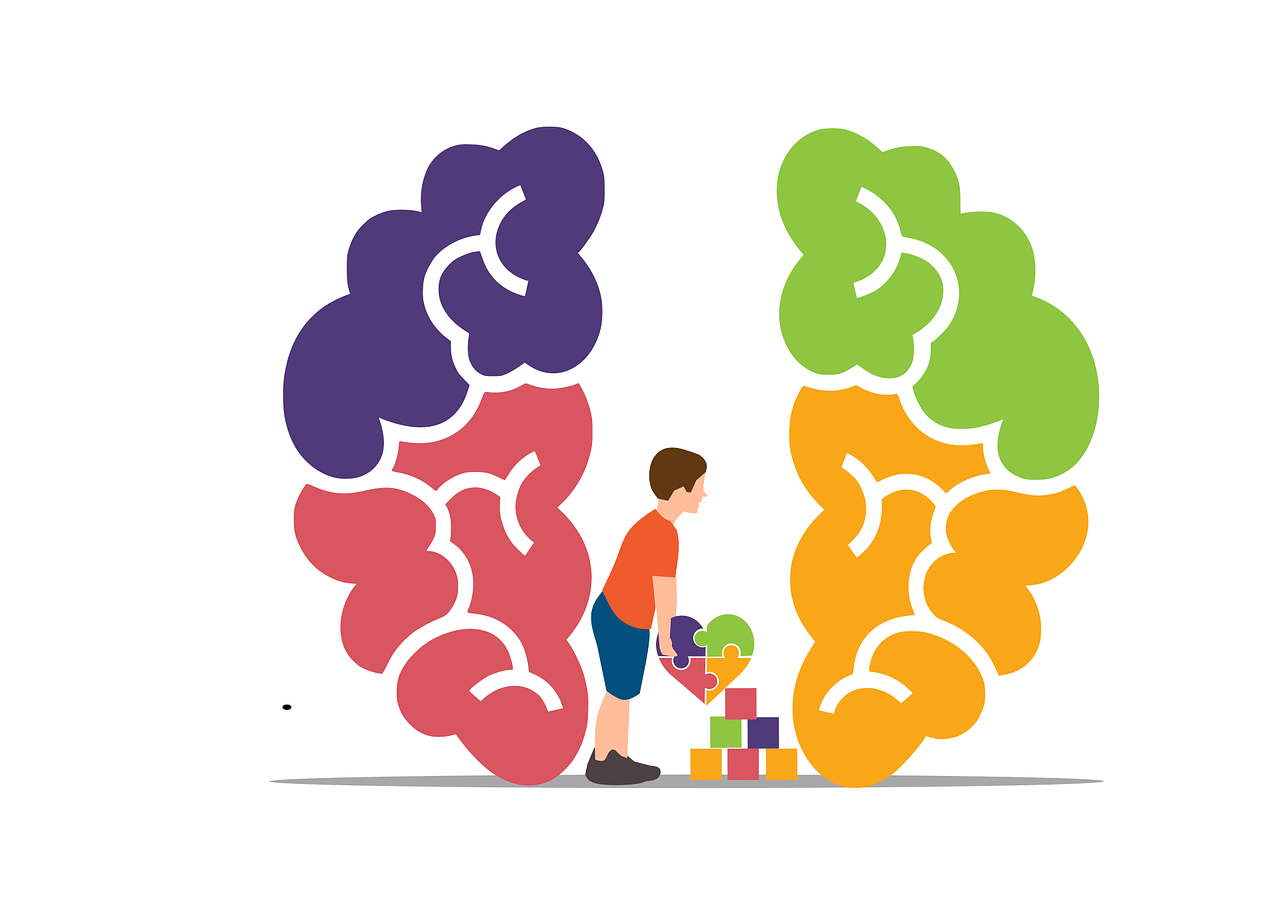
When Love Looks Like Logic: Co-Parenting with a Neurodivergent Partner
They didn't forget your child's concert to hurt you. They didn't shut down during the argument to win it. Understanding the difference between neurodivergence and something more troubling could change everything.

You find yourself wondering: Is my partner selfish, mentally ill, or just wired completely differently from me? And does it even matter when the kids are watching?
Co-parenting is hard under any circumstances. Add neurodivergence to the mix — an autism spectrum profile, ADHD, OCD, or a combination. The challenges take on a particular quality that most parenting books don't touch. The silences that feel like coldness. The rigidity that looks like control. The emotional unavailability that reads, to an exhausted partner, like narcissism.
And here's the brutal truth: many neurodivergent people have been misdiagnosed, misjudged, or left entirely unlabelled for decades. Their partners, and sometimes their own therapists, have reached for the wrong explanations. Narcissistic personality disorder. Bipolar disorder. Emotional immaturity. Passive aggression.
Sometimes those labels fit. But often they don't. And when they don't, the misdiagnosis doesn't just harm the individual — it reshapes an entire family's understanding of itself, in ways that are very hard to undo.
01
What co-parenting with a neurodivergent partner actually looks like
Before we can talk about what gets misread, we need to name what is actually happening. Neurodivergent parenting patterns are real, consistent, and tied to how the brain processes information — not to how much someone loves their children or their partner.
The insistence on the same bedtime ritual, the same route to school, the same dinner on certain nights — this is not stubbornness. Disruption to routine produces genuine nervous system distress, and what the co-parent experiences as inflexibility is the neurodivergent partner trying to hold themselves together. Similarly, the shutdown during arguments — going quiet, leaving the room, becoming unreachable — is almost never a power move. It is a nervous system that has hit its ceiling.
Then there is what might be called literal parenting: getting the logistics exactly right while missing the emotional register entirely. The neurodivergent parent remembers the permission slip, arranges the dentist appointment, ensures the school bag is packed — and somehow still leaves the child feeling unseen. Not because they don't care. Because the emotional frequency is harder to tune into in real time.
After a day of masking at work, performing neurotypically for eight to twelve hours, many autistic or ADHD parents return home genuinely depleted in a way that is difficult to overstate. What the co-parent reads as choosing work over family, or simply not being present, is often a nervous system running on empty. And the hyper-focus that can look like favoritism or an intense investment in one child's interests while another seems overlooked is monotropic attention at work, not a conscious preference.
For the neurotypical co-parent, these patterns can feel impossible to live with. The key question is always: what is driving the behavior? Because the intervention depends entirely on the answer.
02
Why is it confused with narcissism?
Narcissistic personality disorder and autism spectrum profiles can look remarkably similar on the surface, particularly in a parenting or relationship context. Both can involve an apparent lack of empathy, difficulty seeing another person's perspective, and a seeming prioritization of their own needs and systems over the family's emotional well-being.
But the mechanism underneath is completely different. In NPD, the absence of empathy is rooted in a fragile ego structure that requires constant external validation. The self is the center, and others, including children, exist to serve that self-image. When that self-image is threatened, the response is often rage, punishment, or manipulation.
In autism, the apparent absence of empathy is more often a transmission problem than an absence of feeling. The person feels deeply, but the neurological pathway for reading and responding to others' emotional states in real time does not work the way it does for neurotypical people. They may be overwhelmed by their own emotional experience precisely because they care.
What partners often say and why both readings feel true
When a co-parent says, "he never seems to care how I feel - I could be crying in the next room, and he'd keep watching television," that experience is real. It is also consistent with both NPD and autism. In NPD, the disregard is often deliberate - empathy withheld as a form of control. In autism, the emotional cue simply hasn't registered. The partner is not being ignored on purpose; the signal hasn't arrived.
When a co-parent says, "she turns everything into a debate - there's no warmth, just logic and rules," the NPD reading is that she needs to dominate and cannot tolerate losing. The neurodivergent reading is that emotionally charged conversations are processed through the analytical brain because that is the only reliable tool available under pressure.
When a co-parent says, "he just disappears when things get hard - I'm left handling everything alone," the NPD reading is avoidance of accountability. The neurodivergent reading is a genuine nervous system shutdown. Not a choice, but a ceiling reached.
Every one of those experiences is valid. They are also consistent with both presentations, which is exactly why the distinction matters so much. The intervention for NPD is firm limits, often reduced contact. The intervention for an autistic partner in distress is understanding, predictability, and explicit communication. Getting this wrong doesn't just damage the relationship — it harms the children who are forming their own story about the parent they're watching.
Misidentifying your partner's neurodivergence as narcissism doesn't just affect your relationship. It teaches your children a story about their parents that may never be corrected.
From clinical practice in neurodivergent family therapy
The most important question to ask is: Is there remorse? Does your partner show genuine distress when they understand they have caused harm - even if that understanding comes slowly or late? And: Is there a pattern of exploitation? Or is the pattern one of overwhelm, shutdown, and genuine confusion about what just happened?
03
Why is it confused with bipolar disorder?
The bipolar confusion tends to emerge most clearly around what co-parents describe as mood swings - but what is actually happening is often something quite different.
Autistic people and those with ADHD can experience something called rejection sensitive dysphoria - an intense, almost physical emotional reaction to perceived criticism, failure, or social exclusion. It arrives fast, feels catastrophic, and often passes relatively quickly. To an outside observer, this looks exactly like a mood episode. But where a bipolar mood episode may have no identifiable trigger and can last days or weeks, rejection sensitive dysphoria has a specific cause - however small it might seem from the outside - and usually resolves within hours.
What looks like mania in a neurodivergent partner is often hyperfocus on a new interest or project. It can seem excessive, even grandiose - but it is grounded in reality in a way that true mania is not. What looks like depression is frequently autistic burnout: a state of functional depletion that follows extended periods of masking, sensory overload, or social stress. The person becomes withdrawn, irritable, unable to engage with the children, and sometimes barely able to leave the house. It can last weeks or months. It looks like a depressive episode. It is not the same thing, and treating it as depression, particularly with medication designed for mood disorders, often makes it considerably worse.
The difficulty with parenting responsibilities also presents differently. In bipolar disorder, there is often a pattern of high-functioning periods between episodes, with significant deterioration during them. In ADHD, the difficulties are chronic: the forgetting, the delays, the avoidance are present most of the time, not cyclically. In autism, capacity varies with sensory and cognitive load. The parent who managed school pickup perfectly last week may fall apart this week because something in the environment has changed in ways that are not always apparent to others.
The key differentiator is this: in bipolar disorder, mood episodes can arise without an identifiable external trigger. In neurodivergent presentations, there is almost always a trigger. Even if it takes some detective work to find it. The behavior is reactive, not spontaneous. That distinction, held carefully, changes everything about how a family and a clinician should respond.
04
What this does to the children
Children who grow up in households where a parent's neurodivergence is unnamed, misnamed, or misunderstood absorb the confusion. Without a framework to make sense of what they are seeing, they write their own stories - and those stories are rarely generous.
- "Dad doesn't care about us" - when he is overwhelmed and cannot show it
- "Mum is unpredictable and scary" - when she is in sensory overload or burnout
- "I have to manage my parents' emotions" - when no one else has named what is happening
- "Something is wrong with our family" — without the language to understand what or why
- "I caused this" — when a meltdown or shutdown follows something the child did
This is not about assigning blame to the neurodivergent parent. It is about what happens when a family is navigating a dynamic without a map. When a child understands that their parent's brain processes the world differently, that the shutdown is not rejection, that the rigidity is not cruelty, and the story changes. And so does the child's relationship with their own experience of it.
There is also a genetic dimension that co-parents often miss: neurodivergence runs in families. A child who is struggling at school, who is socially isolated, who melts down over textures or transitions may not be "difficult." They may be wired very much like the parent who is being misread as narcissistic or bipolar. Seeing the parent clearly is often the first step toward seeing the child clearly.
05
What actually helps and for both of you
The good news, and it is genuine: neurodivergent co-parenting can work. Not by expecting the neurodivergent partner to become neurotypical. That will never happen, and the expectation will corrode both of you. But by building systems, language, and understanding that work for the actual brains in the room.
- A formal assessment, if one hasn't happened - knowledge is not a label, it is a map
- Couples therapy with a clinician who actually understands neurodivergence - most don't, and it matters enormously
- Explicit communication structures: written agreements, shared calendars, clear parenting protocols that reduce cognitive load on everyone
- Reducing the expectation of spontaneous emotional attunement and building in structured check-ins instead
- Sensory and executive function accommodations in the home environment - this is not indulgence, it keeps everyone regulated
- Psychoeducation for children, age-appropriately framed - they can understand more than we tend to give them credit for
- Separate individual support for the neurotypical partner - this role is genuinely demanding, and the grief involved in adjusting expectations deserves its own space
None of this is to say that a neurodivergent diagnosis explains away harmful behavior, or that co-parents should accept anything in the name of neurodivergence. Neurodivergence does not cause abuse. It does not cause contempt. It does not cause a pattern of deliberate harm. Those things require a different kind of attention entirely.
But for the majority of families navigating these dynamics, where the pain is real, the love is real, and the understanding is just missing - getting the right map changes everything. Not immediately. Not without grief. But genuinely.
Because the question was never whether your partner is a good person. The question was whether you were both trying to find each other across a gap that neither of you fully understood.
Ready to get some clarity?
You don't have to figure this out alone.
Whether you're the neurodivergent partner trying to understand your impact, the co-parent trying to make sense of what's happening, or somewhere in between, a single conversation can make a great deal of difference. We work with neurodivergent families every day, and we know how to hold both sides of this with care.