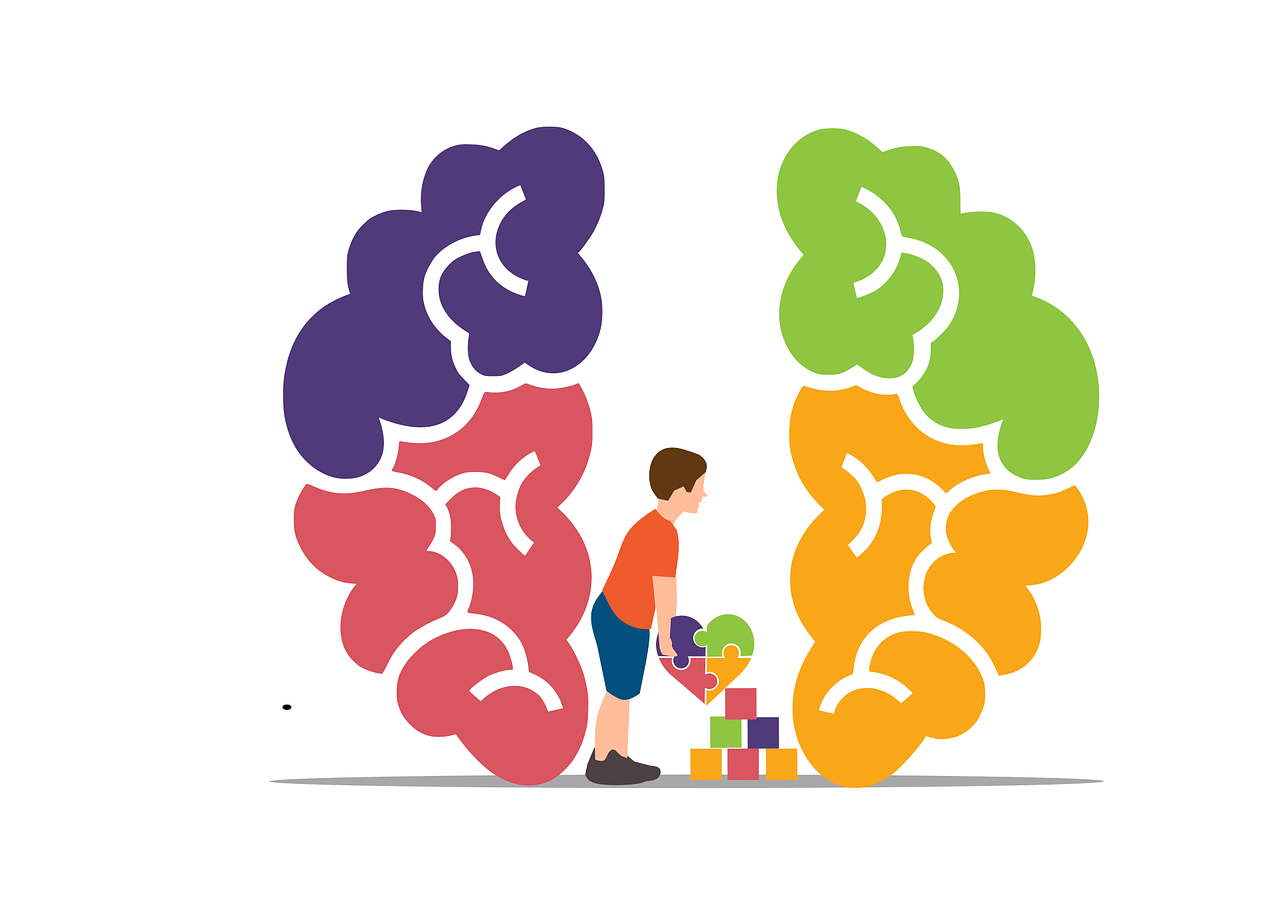
Big Feelings for Small Things? Maybe Not If You Are Twice-Exceptional
For gifted neurodivergent individuals, another person's inconsistent or illogical self-expression doesn't just feel confusing — it can set off a chain reaction in the body that arrives well before any conscious thought has a chance to intervene.

Greatest Moments Therapy · April 2026 · 9 min read
─────────────────────────────────────────────
A client recently described it to me this way: "When someone says something that isn't quite accurate, I can't just let it go. It's like a splinter. I keep coming back to it."
He is 26, extraordinarily bright, and has spent much of his young adult life being told he is "too sensitive," "too intense," or simply "difficult." He is none of those things. He is neurodivergent, twice-exceptional, and wired in a way that makes other people's imprecise, illogical, or self-contradictory expressions feel, in the body, not just the mind, like something is wrong.
Before going further, it's worth pausing on two terms that are often used loosely — because precision matters here.
WHAT IS NEURODIVERGENT?
A brain that is wired differently from what is considered typical — not broken, not disordered, just built along different lines. Neurodivergent people process information, regulate emotion, and experience the world in ways that diverge from the statistical norm.
This umbrella includes Traits or Fully Met Criteria that Cause Significant Difficulty with Adjustment, such as ADHD, Autism spectrum, Dyslexia, Dyspraxia, Dyscalculia, Sensory processing differences, and Tourette syndrome.
WHAT IS TWICE-EXCEPTIONAL?
The combination of significant intellectual giftedness with one or more neurodivergent profiles. The "twice" refers to two exceptionalities at once — exceptional ability and exceptional challenge, often in the same person, sometimes even in the same task.
Twice-exceptional individuals are frequently misread — their giftedness masks their struggles, and their struggles can obscure their gifts. They often fall through the cracks of systems designed for one or the other, not both.
─────────────────────────────────────────────
WHY MOST PEOPLE SOUND IMPRECISE - AND DON'T KNOW IT
To understand what happens inside the twice-exceptional nervous system, it helps first to understand what is actually going on when most people communicate. Because the imprecision is real, it is just not what it appears to be.
Most people do not arrive at a conversation already knowing what they think. They find out by talking. Language, for the majority of people, is not a delivery system for pre-formed ideas — it is the process by which meaning gets constructed in real time. Words come out ahead of clarity. A story shifts not because the person is being evasive, but because the act of telling it continues to shape what it means to them.
There are several distinct reasons this happens, and understanding them is itself a therapeutic tool:
Emotional shorthand
People exaggerate or simplify to convey how something felt, not what literally happened. "Everyone hates me" means "I felt very alone." The feeling is accurate; the words are an approximation.
Narrative drift
Many people think by speaking. Their account shifts mid-sentence because their brain is constructing meaning in real time — not revising a lie, but completing a thought that wasn't fully formed when it began.
Low-resolution self-awareness
Most people have limited conscious access to their own inner states. They describe what they feel or want imprecisely because they genuinely don't know yet — and talking is how they find out.
Social performance
People often say what they believe they are supposed to say, or what seems most acceptable in the moment — not as manipulation, but as an automatic social reflex they may not even notice themselves doing.
None of these is deception. They are the texture of how most human minds communicate. The words are exploratory, not declarative. The Inconsistency is not a cover. It is the actual process of thinking out loud. Expecting precision in everyday conversation is a little like being frustrated that people walk instead of calculating optimal movement vectors. It is simply not how the system works for most people.
"For most people, talking is not reporting on what they already know. It is how they find out what they know."
─────────────────────────────────────────────
THE TRIGGER: WHEN OTHER PEOPLE'S WORDS DON'T ADD UP
For the twice-exceptional individual, none of this is obvious — and it is not easy to accept even when explained. Because their own relationship to language is fundamentally different, they typically know what they mean before they speak. They choose words with care. They notice when their own account of something is inconsistent, and they correct it. The idea that someone might say something imprecise without noticing — or without it meaning something — can feel genuinely implausible.
So when Inconsistency in another person's self-expression is detected — contradictions, tangential logic, words that don't match behavior, accounts that shift — it registers not as ordinary human imprecision but as a signal that something is wrong. The pattern-recognition system, finely tuned and operating at high speed, catches the mismatch and flags it immediately. And what follows that flag is not a thought. It is a physical response.
"It isn't that they're choosing to overreact. It's that the body has already reacted before the choice was available."
─────────────────────────────────────────────
THE AUTOMATIC LEAP: FROM INCONSISTENCY TO ALARM
At the heart of much of this reactivity is a cognitive distortion that operates faster than conscious thought: the automatic assumption that when someone's account of themselves is inconsistent, contradictory, or imprecise, they must be doing it on purpose. That the shifting story is a cover. That the imprecision is strategic.
This leap from Inconsistency to intentional deception is not just a thought. It is a physiological event. The moment the brain flags a perceived threat to trust or truth, the autonomic nervous system activates. Heart rate rises. Muscles tighten. The body is already in a defensive posture, flooded with the chemistry of alarm and mobilized, before any conscious thought has had a chance to form, let alone question the interpretation.
By the time the person might otherwise pause to reflect and consider an alternative explanation, the window has already closed. What follows, the sharp remark, the withdrawal, the relentless internal replay, is not a choice. It is a body in a threat response, doing exactly what it was built to do.
HOW THE SEQUENCE UNFOLDS — FASTER THAN THOUGHT
1 · Inconsistency detected
Pattern recognition flags a mismatch. What's being said now doesn't line up with what was said before.
2 · Automatic attribution of intent
The brain assigns meaning: this must be deliberate — they are choosing to mislead.
3 · Autonomic Nervous System activation
The body responds to perceived threat — heart rate rises, muscles tighten, cortisol spikes. This happens in milliseconds, before any conscious thought.
4 · Reactivity
Words or actions emerge from a flooded nervous system — not from considered choice.
5 · The window closes
The capacity to pause, integrate, and regulate arrives too late — the response has already happened.
This is what makes the pattern so difficult to interrupt. It is not a matter of trying harder or wanting to do better. The body has been activated before the mind was even consulted. Telling someone to "just calm down" or "think before you react" misses the point entirely. Thinking wasn't available yet.
─────────────────────────────────────────────
WHY THE TWICE-EXCEPTIONAL BRAIN IS ESPECIALLY VULNERABLE
Twice-exceptional individuals often have finely calibrated pattern recognition systems. They detect inconsistencies between words and meaning almost automatically, with something close to physical immediacy. When someone's self-expression is imprecise, their brain doesn't file it as "approximation." It flags it as an error, and errors in a brain wired for accuracy and justice sensitivity demand resolution.
Layer onto this the affective intensity common in this population, heightened emotional processing, often called overexcitabilities, and you have a nervous system that is not just noticing the gap, but experiencing it as a genuine threat. The speed of ANS activation in these individuals is often significantly faster than the norm, leaving an even narrower window for regulation to intervene.
Four characteristics that make this population especially vulnerable:
Hyper-literal processing — Words trigger immediate truth-evaluation, bypassing social interpretation.
Pattern sensitivity — Inconsistencies are almost physically noticeable — hard to ignore selectively.
Justice-sensitivity — Letting imprecision pass can feel like complicity rather than grace.
Low tolerance for cognitive noise — Tangential thinking feels like interference, not just a different style.
This means the reactivity is not a character flaw. It is a processing style mismatch. Other people are not running the same verification layer. The first therapeutic task is helping clients genuinely internalize that distinction. Intellectually and in the body.
─────────────────────────────────────────────
BUILDING THE BUFFER: THE MICRO-PROCESS
Because ANS activation precedes conscious thought, the goal is not to stop noticing. Noticing is valuable, and suppressing it would mean losing one of a twice-exceptional person's genuine strengths. The goal is to decouple noticing from reacting and to preserve the perception while creating enough space for the mind to catch up with the body.
In practice, this begins with inserting a deliberate micro-process between the trigger and the response. Initially, it is slow and conscious. With repetition, it becomes faster, nearly automatic, without losing the underlying awareness.
1 Detect "I'm registering an inaccuracy or illogical tangent."
2 Classify "Is this malicious — or is this just how most people communicate?"
3 Translate "What are they actually trying to say beneath the imprecision?"
4 Choose. "Do I need to correct this — or can I respond to the intent?"
Alongside this cognitive micro-process, several practical in-the-moment techniques support regulation when the nervous system is already activated:
Anthropologist mode
Observe the other person as fascinating data rather than someone making claims that need evaluating. Curiosity is neurologically incompatible with reactivity — it activates a different part of the brain entirely.
Lower the stakes
Ask yourself, "Does this inaccuracy actually affect anything important? In 5 min, in 5 hours, in 5 months?" In most interactions, it doesn't. When the stakes are genuinely low, the nervous system can be reminded of that, and it will often downregulate in response.
Respond to context and subtext, not text.
Reflect the feeling beneath the imprecise words rather than addressing the inaccuracy itself. "It sounds like you felt really overwhelmed" bypasses the factual error and speaks to what the person was actually trying to convey, which is usually more useful to them anyway. It is more useful to them, lowers their emotionality, and the communication becomes more factual and less activating.
Physical anchor
A breath, a grounding sensation, or a small, deliberate movement (e.g., feet flat on the floor, hands on a surface, progressive muscle relaxation with arms and shoulders, bilateral tapping) creates the fraction of a second needed to interrupt the automatic sequence and choose a response rather than react.
The three-second pause
Give yourself explicit permission to wait three seconds before responding to anything that triggers the "that's wrong" signal. The pause is not passive. It is the intervention.
─────────────────────────────────────────────
TREATMENT: WORKING DEEPER WITH THE NERVOUS SYSTEM
In-the-moment techniques build the buffer. Longer-term clinical work addresses the underlying sensitization, the accumulated charge from a lifetime of being a precise, pattern-sensitive person in an imprecise world. Several modalities are particularly well-suited to this population.
Resourcing
Before any processing work can begin, the nervous system needs something stable to return to. Resourcing develops internal and relational anchors of safety, calm, and competence. For clients with a baseline of chronic vigilance, resourcing is not a preliminary step. It is the work itself, establishing the ground from which everything else becomes possible.
EMDR
Eye Movement Desensitization and Reprocessing targets the stored charge around past experiences of being misled, dismissed, or chronically misunderstood. Repeated encounters with social confusion leave a residue — sensitizing the nervous system so present-day triggers carry the weight of accumulated past ones. EMDR helps process and discharge that residue, reducing the hair-trigger quality of the response.
Internal Family Systems (IFS)
IFS helps clients identify which part of them is activated by the trigger, often a protective part with deep historical roots, and build a relationship with it rather than being run by it. The part that fires the alarm is not the enemy. It learned its job for a reason. IFS makes it possible to honor that history while expanding the repertoire of available responses.
Somatic regulation and DBT
Body-based anchoring practices widen the window of tolerance in the moment. DBT-informed interpersonal effectiveness skills provide practical tools for navigating interactions when regulation is only partial. Tracking the pattern through journaling (when it happens, with whom, and around what type of imprecision) often reveals that the triggers are not random and that this insight alone begins to shift the response.
"Because the body sounds the alarm before the mind has spoken, the path to regulation has to run through the nervous system — not around it."
─────────────────────────────────────────────
THE CORE SHIFT
The goal of this work is not to stop noticing. The noticing is one of the twice-exceptional person's most valuable capacities — sharp, fast, and often accurate. The goal is to decouple noticing from reacting: to perceive the imprecision, file it, and still respond warmly and effectively. To respond to what someone meant rather than what they said.
Clients who do this work describe a shift that is less about caring less and more about suffering less. The nervous system gradually learns that another person's imprecision is not an emergency. The window between perception and reaction widens not by suppressing the signal, but by giving the body enough stability to hold it without acting on it immediately.
In that widened window, something new becomes possible: a genuine pause. A moment to integrate, to translate, to choose. That gap between perception and reaction is where emotional intelligence lives. And it can be built and maintained.
─────────────────────────────────────────────
If you recognize yourself or someone you love in what's described here, this work is available to you. Our practice specializes in assessment and therapy for neurodivergent, twice-exceptional individuals navigating affect regulation, identity, and relational complexity. Reach out to schedule a consultation here